Post 2 of 4 in The Narrowing EMR series.
KEY TAKEAWAYS
- The binding question for health systems in 2026 is not which AI vendor or EHR AI capability to choose. It is who gets to decide what AI runs against clinical data, under what constraints, and with what accountability.
- Most digital governance committees stall on AI tool approvals not because tools lack merit or budget, but because no one can answer who has decision authority over clinical data access.
- Epic’s Agent Factory lets health systems build agents inside Epic’s environment — but does not, based on publicly available documentation, support open agent-interoperability standards (MCP, Agent2Agent) that Microsoft, Salesforce, AWS, and Oracle are participating in.
- Oracle Health’s OCI-native EHR positions the patient record in a model-agnostic cloud data platform (OHDI), with the EHR application as one consumer of that data rather than the owner of it.
- The technical floor for building a clinically useful AI agent has dropped by one organizational layer per decade. Within 3-5 years, a clinically trained staff member may configure a workflow agent against hospital data in days rather than quarters.
- Governance architecture defaults to an answer whether or not leadership has articulated one. The 2026 architecture — chosen before AI agents were a category — is already answering the governance question on most health systems’ behalf.
I’ve sat through this meeting in some form more times than I can count. A CMIO walks into a health system’s digital governance committee with a simple-sounding ask: a clinically useful ambient AI tool, a third-party population health agent, or an ML-driven prior authorization assistant. The tool works. The vendor is credible. The clinicians asked for it. The ROI is there and the budget holds. Forty minutes later, the meeting adjourns without a decision, and the reason almost never hinges on whether the tool actually works, whether it pays for itself, or whether anyone wants it.
The reason is that no one in the room can answer, cleanly, a more basic question: who actually decides what runs against our clinical data, under what controls, with what accountability?
That question, not the tool question, is the whole EMR strategy conversation in miniature. And almost no one in healthcare IT is framing it that way.
The Governance Reframe: Why the AI Question Is Not Technical
If you read the healthcare AI press, you’d think the industry’s central decision in 2026 is technical. Which model, which vendor, which deployment pattern? That framing is not wrong so much as downstream. Every one of those technical questions resolves once the governance question resolves.
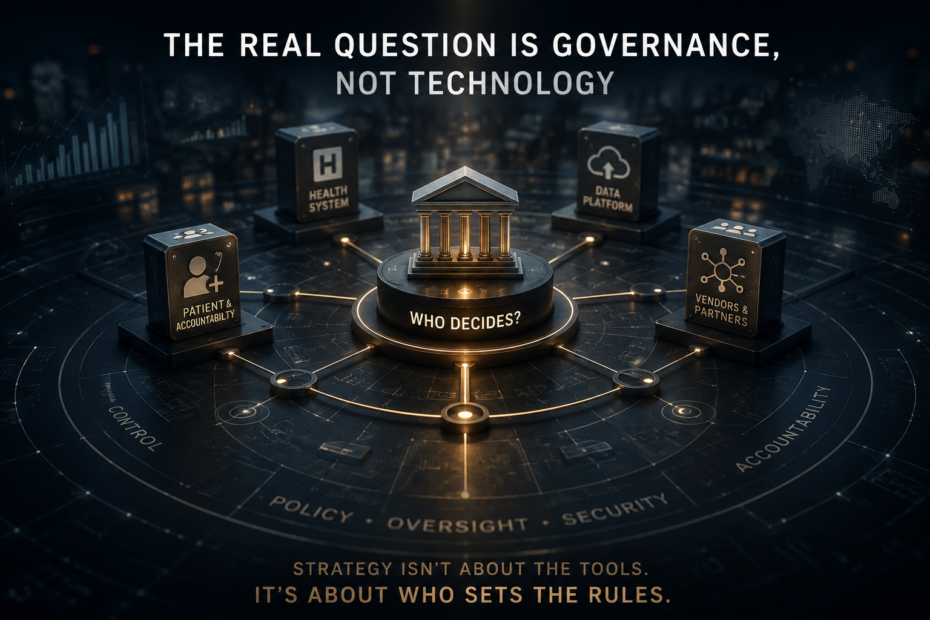
The binding question for health system leadership in 2026 is not which AI vendor or which EHR AI capability. It is who gets to decide what AI runs against the hospital’s clinical data, under what constraints, and with what accountability.
That is an enterprise data and agent governance question, distinct from how a health system governs its Epic implementation internally. That question has an answer in your architecture, whether you’ve articulated it or not. And in 2026, the architecture you chose before AI agents were a category is the architecture that is answering it on your behalf.
![{"type":"elementor","siteurl":"https://www.abundant.healthcare/wp-json/","elements":[{"id":"de39824","elType":"widget","isInner":false,"isLocked":false,"settings":{"image":{"url":"https://www.abundant.healthcare/wp-content/uploads/2026/05/Healthcare-IT-Strategy-e1780070128751.png","id":1727,"size":"","alt":"Healthcare IT Strategy","source":"library"},"image_size":"large","image_custom_dimension":{"width":"","height":""},"caption_source":"none","caption":"","link_to":"none","link":{"url":"","is_external":"","nofollow":"","custom_attributes":""},"open_lightbox":"default","align":"","align_tablet":"","align_mobile":"","width":{"unit":"%","size":"","sizes":[]},"width_tablet":{"unit":"%","size":"","sizes":[]},"width_mobile":{"unit":"%","size":"","sizes":[]},"space":{"unit":"%","size":"","sizes":[]},"space_tablet":{"unit":"%","size":"","sizes":[]},"space_mobile":{"unit":"%","size":"","sizes":[]},"height":{"unit":"px","size":"","sizes":[]},"height_tablet":{"unit":"px","size":"","sizes":[]},"height_mobile":{"unit":"px","size":"","sizes":[]},"object-fit":"","object-fit_tablet":"","object-fit_mobile":"","object-position":"center center","object-position_tablet":"","object-position_mobile":"","opacity":{"unit":"px","size":"","sizes":[]},"css_filters_css_filter":"","css_filters_blur":{"unit":"px","size":0,"sizes":[]},"css_filters_brightness":{"unit":"px","size":100,"sizes":[]},"css_filters_contrast":{"unit":"px","size":100,"sizes":[]},"css_filters_saturate":{"unit":"px","size":100,"sizes":[]},"css_filters_hue":{"unit":"px","size":0,"sizes":[]},"opacity_hover":{"unit":"px","size":"","sizes":[]},"css_filters_hover_css_filter":"","css_filters_hover_blur":{"unit":"px","size":0,"sizes":[]},"css_filters_hover_brightness":{"unit":"px","size":100,"sizes":[]},"css_filters_hover_contrast":{"unit":"px","size":100,"sizes":[]},"css_filters_hover_saturate":{"unit":"px","size":100,"sizes":[]},"css_filters_hover_hue":{"unit":"px","size":0,"sizes":[]},"background_hover_transition":{"unit":"px","size":"","sizes":[]},"hover_animation":"","image_border_border":"","image_border_width":{"unit":"px","top":"","right":"","bottom":"","left":"","isLinked":true},"image_border_width_tablet":{"unit":"px","top":"","right":"","bottom":"","left":"","isLinked":true},"image_border_width_mobile":{"unit":"px","top":"","right":"","bottom":"","left":"","isLinked":true},"image_border_color":"","image_border_radius":{"unit":"px","top":"","right":"","bottom":"","left":"","isLinked":true},"image_border_radius_tablet":{"unit":"px","top":"","right":"","bottom":"","left":"","isLinked":true},"image_border_radius_mobile":{"unit":"px","top":"","right":"","bottom":"","left":"","isLinked":true},"image_box_shadow_box_shadow_type":"","image_box_shadow_box_shadow":{"horizontal":0,"vertical":0,"blur":10,"spread":0,"color":"rgba(0,0,0,0.5)"},"caption_align":"","caption_align_tablet":"","caption_align_mobile":"","text_color":"","caption_background_color":"","caption_typography_typography":"","caption_typography_font_family":"","caption_typography_font_size":{"unit":"px","size":"","sizes":[]},"caption_typography_font_size_tablet":{"unit":"px","size":"","sizes":[]},"caption_typography_font_size_mobile":{"unit":"px","size":"","sizes":[]},"caption_typography_font_weight":"","caption_typography_text_transform":"","caption_typography_font_style":"","caption_typography_text_decoration":"","caption_typography_line_height":{"unit":"px","size":"","sizes":[]},"caption_typography_line_height_tablet":{"unit":"em","size":"","sizes":[]},"caption_typography_line_height_mobile":{"unit":"em","size":"","sizes":[]},"caption_typography_letter_spacing":{"unit":"px","size":"","sizes":[]},"caption_typography_letter_spacing_tablet":{"unit":"px","size":"","sizes":[]},"caption_typography_letter_spacing_mobile":{"unit":"px","size":"","sizes":[]},"caption_typography_word_spacing":{"unit":"px","size":"","sizes":[]},"caption_typography_word_spacing_tablet":{"unit":"em","size":"","sizes":[]},"caption_typography_word_spacing_mobile":{"unit":"em","size":"","sizes":[]},"caption_text_shadow_text_shadow_type":"","caption_text_shadow_text_shadow":{"horizontal":0,"vertical":0,"blur":10,"color":"rgba(0,0,0,0.3)"},"caption_space":{"unit":"px","size":"","sizes":[]},"caption_space_tablet":{"unit":"px","size":"","sizes":[]},"caption_space_mobile":{"unit":"px","size":"","sizes":[]},"_title":"","_margin":{"unit":"px","top":"","right":"","bottom":"","left":"","isLinked":true},"_margin_tablet":{"unit":"px","top":"","right":"","bottom":"","left":"","isLinked":true},"_margin_mobile":{"unit":"px","top":"","right":"","bottom":"","left":"","isLinked":true},"_padding":{"unit":"px","top":"","right":"","bottom":"","left":"","isLinked":true},"_padding_tablet":{"unit":"px","top":"","right":"","bottom":"","left":"","isLinked":true},"_padding_mobile":{"unit":"px","top":"","right":"","bottom":"","left":"","isLinked":true},"_element_width":"","_element_width_tablet":"","_element_width_mobile":"","_element_custom_width":{"unit":"%","size":"","sizes":[]},"_element_custom_width_tablet":{"unit":"px","size":"","sizes":[]},"_element_custom_width_mobile":{"unit":"px","size":"","sizes":[]},"_grid_column":"","_grid_column_tablet":"","_grid_column_mobile":"","_grid_column_custom":"","_grid_column_custom_tablet":"","_grid_column_custom_mobile":"","_grid_row":"","_grid_row_tablet":"","_grid_row_mobile":"","_grid_row_custom":"","_grid_row_custom_tablet":"","_grid_row_custom_mobile":"","_element_vertical_align":"","_element_vertical_align_tablet":"","_element_vertical_align_mobile":"","_position":"","_offset_orientation_h":"start","_offset_x":{"unit":"px","size":0,"sizes":[]},"_offset_x_tablet":{"unit":"px","size":"","sizes":[]},"_offset_x_mobile":{"unit":"px","size":"","sizes":[]},"_offset_x_end":{"unit":"px","size":0,"sizes":[]},"_offset_x_end_tablet":{"unit":"px","size":"","sizes":[]},"_offset_x_end_mobile":{"unit":"px","size":"","sizes":[]},"_offset_orientation_v":"start","_offset_y":{"unit":"px","size":0,"sizes":[]},"_offset_y_tablet":{"unit":"px","size":"","sizes":[]},"_offset_y_mobile":{"unit":"px","size":"","sizes":[]},"_offset_y_end":{"unit":"px","size":0,"sizes":[]},"_offset_y_end_tablet":{"unit":"px","size":"","sizes":[]},"_offset_y_end_mobile":{"unit":"px","size":"","sizes":[]},"_z_index":"","_z_index_tablet":"","_z_index_mobile":"","_element_id":"","_css_classes":"","_element_cache":"","_animation":"","_animation_tablet":"","_animation_mobile":"","animation_duration":"","_animation_delay":"","_transform_rotate_popover":"","_transform_rotateZ_effect":{"unit":"px","size":"","sizes":[]},"_transform_rotateZ_effect_tablet":{"unit":"deg","size":"","sizes":[]},"_transform_rotateZ_effect_mobile":{"unit":"deg","size":"","sizes":[]},"_transform_rotate_3d":"","_transform_rotateX_effect":{"unit":"px","size":"","sizes":[]},"_transform_rotateX_effect_tablet":{"unit":"deg","size":"","sizes":[]},"_transform_rotateX_effect_mobile":{"unit":"deg","size":"","sizes":[]},"_transform_rotateY_effect":{"unit":"px","size":"","sizes":[]},"_transform_rotateY_effect_tablet":{"unit":"deg","size":"","sizes":[]},"_transform_rotateY_effect_mobile":{"unit":"deg","size":"","sizes":[]},"_transform_perspective_effect":{"unit":"px","size":"","sizes":[]},"_transform_perspective_effect_tablet":{"unit":"px","size":"","sizes":[]},"_transform_perspective_effect_mobile":{"unit":"px","size":"","sizes":[]},"_transform_translate_popover":"","_transform_translateX_effect":{"unit":"px","size":"","sizes":[]},"_transform_translateX_effect_tablet":{"unit":"px","size":"","sizes":[]},"_transform_translateX_effect_mobile":{"unit":"px","size":"","sizes":[]},"_transform_translateY_effect":{"unit":"px","size":"","sizes":[]},"_transform_translateY_effect_tablet":{"unit":"px","size":"","sizes":[]},"_transform_translateY_effect_mobile":{"unit":"px","size":"","sizes":[]},"_transform_scale_popover":"","_transform_keep_proportions":"yes","_transform_scale_effect":{"unit":"px","size":"","sizes":[]},"_transform_scale_effect_tablet":{"unit":"px","size":"","sizes":[]},"_transform_scale_effect_mobile":{"unit":"px","size":"","sizes":[]},"_transform_scaleX_effect":{"unit":"px","size":"","sizes":[]},"_transform_scaleX_effect_tablet":{"unit":"px","size":"","sizes":[]},"_transform_scaleX_effect_mobile":{"unit":"px","size":"","sizes":[]},"_transform_scaleY_effect":{"unit":"px","size":"","sizes":[]},"_transform_scaleY_effect_tablet":{"unit":"px","size":"","sizes":[]},"_transform_scaleY_effect_mobile":{"unit":"px","size":"","sizes":[]},"_transform_skew_popover":"","_transform_skewX_effect":{"unit":"px","size":"","sizes":[]},"_transform_skewX_effect_tablet":{"unit":"deg","size":"","sizes":[]},"_transform_skewX_effect_mobile":{"unit":"deg","size":"","sizes":[]},"_transform_skewY_effect":{"unit":"px","size":"","sizes":[]},"_transform_skewY_effect_tablet":{"unit":"deg","size":"","sizes":[]},"_transform_skewY_effect_mobile":{"unit":"deg","size":"","sizes":[]},"_transform_flipX_effect":"","_transform_flipY_effect":"","_transform_rotate_popover_hover":"","_transform_rotateZ_effect_hover":{"unit":"px","size":"","sizes":[]},"_transform_rotateZ_effect_hover_tablet":{"unit":"deg","size":"","sizes":[]},"_transform_rotateZ_effect_hover_mobile":{"unit":"deg","size":"","sizes":[]},"_transform_rotate_3d_hover":"","_transform_rotateX_effect_hover":{"unit":"px","size":"","sizes":[]},"_transform_rotateX_effect_hover_tablet":{"unit":"deg","size":"","sizes":[]},"_transform_rotateX_effect_hover_mobile":{"unit":"deg","size":"","sizes":[]},"_transform_rotateY_effect_hover":{"unit":"px","size":"","sizes":[]},"_transform_rotateY_effect_hover_tablet":{"unit":"deg","size":"","sizes":[]},"_transform_rotateY_effect_hover_mobile":{"unit":"deg","size":"","sizes":[]},"_transform_perspective_effect_hover":{"unit":"px","size":"","sizes":[]},"_transform_perspective_effect_hover_tablet":{"unit":"px","size":"","sizes":[]},"_transform_perspective_effect_hover_mobile":{"unit":"px","size":"","sizes":[]},"_transform_translate_popover_hover":"","_transform_translateX_effect_hover":{"unit":"px","size":"","sizes":[]},"_transform_translateX_effect_hover_tablet":{"unit":"px","size":"","sizes":[]},"_transform_translateX_effect_hover_mobile":{"unit":"px","size":"","sizes":[]},"_transform_translateY_effect_hover":{"unit":"px","size":"","sizes":[]},"_transform_translateY_effect_hover_tablet":{"unit":"px","size":"","sizes":[]},"_transform_translateY_effect_hover_mobile":{"unit":"px","size":"","sizes":[]},"_transform_scale_popover_hover":"","_transform_keep_proportions_hover":"yes","_transform_scale_effect_hover":{"unit":"px","size":"","sizes":[]},"_transform_scale_effect_hover_tablet":{"unit":"px","size":"","sizes":[]},"_transform_scale_effect_hover_mobile":{"unit":"px","size":"","sizes":[]},"_transform_scaleX_effect_hover":{"unit":"px","size":"","sizes":[]},"_transform_scaleX_effect_hover_tablet":{"unit":"px","size":"","sizes":[]},"_transform_scaleX_effect_hover_mobile":{"unit":"px","size":"","sizes":[]},"_transform_scaleY_effect_hover":{"unit":"px","size":"","sizes":[]},"_transform_scaleY_effect_hover_tablet":{"unit":"px","size":"","sizes":[]},"_transform_scaleY_effect_hover_mobile":{"unit":"px","size":"","sizes":[]},"_transform_skew_popover_hover":"","_transform_skewX_effect_hover":{"unit":"px","size":"","sizes":[]},"_transform_skewX_effect_hover_tablet":{"unit":"deg","size":"","sizes":[]},"_transform_skewX_effect_hover_mobile":{"unit":"deg","size":"","sizes":[]},"_transform_skewY_effect_hover":{"unit":"px","size":"","sizes":[]},"_transform_skewY_effect_hover_tablet":{"unit":"deg","size":"","sizes":[]},"_transform_skewY_effect_hover_mobile":{"unit":"deg","size":"","sizes":[]},"_transform_flipX_effect_hover":"","_transform_flipY_effect_hover":"","_transform_transition_hover":{"unit":"px","size":"","sizes":[]},"motion_fx_transform_x_anchor_point":"","motion_fx_transform_x_anchor_point_tablet":"","motion_fx_transform_x_anchor_point_mobile":"","motion_fx_transform_y_anchor_point":"","motion_fx_transform_y_anchor_point_tablet":"","motion_fx_transform_y_anchor_point_mobile":"","_background_background":"","_background_color":"","_background_color_stop":{"unit":"%","size":0,"sizes":[]},"_background_color_stop_tablet":{"unit":"%"},"_background_color_stop_mobile":{"unit":"%"},"_background_color_b":"#f2295b","_background_color_b_stop":{"unit":"%","size":100,"sizes":[]},"_background_color_b_stop_tablet":{"unit":"%"},"_background_color_b_stop_mobile":{"unit":"%"},"_background_gradient_type":"linear","_background_gradient_angle":{"unit":"deg","size":180,"sizes":[]},"_background_gradient_angle_tablet":{"unit":"deg"},"_background_gradient_angle_mobile":{"unit":"deg"},"_background_gradient_position":"center center","_background_gradient_position_tablet":"","_background_gradient_position_mobile":"","_background_image":{"url":"","id":"","size":""},"_background_image_tablet":{"url":"","id":"","size":""},"_background_image_mobile":{"url":"","id":"","size":""},"_background_position":"","_background_position_tablet":"","_background_position_mobile":"","_background_xpos":{"unit":"px","size":0,"sizes":[]},"_background_xpos_tablet":{"unit":"px","size":0,"sizes":[]},"_background_xpos_mobile":{"unit":"px","size":0,"sizes":[]},"_background_ypos":{"unit":"px","size":0,"sizes":[]},"_background_ypos_tablet":{"unit":"px","size":0,"sizes":[]},"_background_ypos_mobile":{"unit":"px","size":0,"sizes":[]},"_background_attachment":"","_background_repeat":"","_background_repeat_tablet":"","_background_repeat_mobile":"","_background_size":"","_background_size_tablet":"","_background_size_mobile":"","_background_bg_width":{"unit":"%","size":100,"sizes":[]},"_background_bg_width_tablet":{"unit":"px","size":"","sizes":[]},"_background_bg_width_mobile":{"unit":"px","size":"","sizes":[]},"_background_video_link":"","_background_video_start":"","_background_video_end":"","_background_play_once":"","_background_play_on_mobile":"","_background_privacy_mode":"","_background_video_fallback":{"url":"","id":"","size":""},"_background_slideshow_gallery":[],"_background_slideshow_loop":"yes","_background_slideshow_slide_duration":5000,"_background_slideshow_slide_transition":"fade","_background_slideshow_transition_duration":500,"_background_slideshow_background_size":"","_background_slideshow_background_size_tablet":"","_background_slideshow_background_size_mobile":"","_background_slideshow_background_position":"","_background_slideshow_background_position_tablet":"","_background_slideshow_background_position_mobile":"","_background_slideshow_lazyload":"","_background_slideshow_ken_burns":"","_background_slideshow_ken_burns_zoom_direction":"in","_background_hover_background":"","_background_hover_color":"","_background_hover_color_stop":{"unit":"%","size":0,"sizes":[]},"_background_hover_color_stop_tablet":{"unit":"%"},"_background_hover_color_stop_mobile":{"unit":"%"},"_background_hover_color_b":"#f2295b","_background_hover_color_b_stop":{"unit":"%","size":100,"sizes":[]},"_background_hover_color_b_stop_tablet":{"unit":"%"},"_background_hover_color_b_stop_mobile":{"unit":"%"},"_background_hover_gradient_type":"linear","_background_hover_gradient_angle":{"unit":"deg","size":180,"sizes":[]},"_background_hover_gradient_angle_tablet":{"unit":"deg"},"_background_hover_gradient_angle_mobile":{"unit":"deg"},"_background_hover_gradient_position":"center center","_background_hover_gradient_position_tablet":"","_background_hover_gradient_position_mobile":"","_background_hover_image":{"url":"","id":"","size":""},"_background_hover_image_tablet":{"url":"","id":"","size":""},"_background_hover_image_mobile":{"url":"","id":"","size":""},"_background_hover_position":"","_background_hover_position_tablet":"","_background_hover_position_mobile":"","_background_hover_xpos":{"unit":"px","size":0,"sizes":[]},"_background_hover_xpos_tablet":{"unit":"px","size":0,"sizes":[]},"_background_hover_xpos_mobile":{"unit":"px","size":0,"sizes":[]},"_background_hover_ypos":{"unit":"px","size":0,"sizes":[]},"_background_hover_ypos_tablet":{"unit":"px","size":0,"sizes":[]},"_background_hover_ypos_mobile":{"unit":"px","size":0,"sizes":[]},"_background_hover_attachment":"","_background_hover_repeat":"","_background_hover_repeat_tablet":"","_background_hover_repeat_mobile":"","_background_hover_size":"","_background_hover_size_tablet":"","_background_hover_size_mobile":"","_background_hover_bg_width":{"unit":"%","size":100,"sizes":[]},"_background_hover_bg_width_tablet":{"unit":"px","size":"","sizes":[]},"_background_hover_bg_width_mobile":{"unit":"px","size":"","sizes":[]},"_background_hover_video_link":"","_background_hover_video_start":"","_background_hover_video_end":"","_background_hover_play_once":"","_background_hover_play_on_mobile":"","_background_hover_privacy_mode":"","_background_hover_video_fallback":{"url":"","id":"","size":""},"_background_hover_slideshow_gallery":[],"_background_hover_slideshow_loop":"yes","_background_hover_slideshow_slide_duration":5000,"_background_hover_slideshow_slide_transition":"fade","_background_hover_slideshow_transition_duration":500,"_background_hover_slideshow_background_size":"","_background_hover_slideshow_background_size_tablet":"","_background_hover_slideshow_background_size_mobile":"","_background_hover_slideshow_background_position":"","_background_hover_slideshow_background_position_tablet":"","_background_hover_slideshow_background_position_mobile":"","_background_hover_slideshow_lazyload":"","_background_hover_slideshow_ken_burns":"","_background_hover_slideshow_ken_burns_zoom_direction":"in","_background_hover_transition":{"unit":"px","size":"","sizes":[]},"_border_border":"","_border_width":{"unit":"px","top":"","right":"","bottom":"","left":"","isLinked":true},"_border_width_tablet":{"unit":"px","top":"","right":"","bottom":"","left":"","isLinked":true},"_border_width_mobile":{"unit":"px","top":"","right":"","bottom":"","left":"","isLinked":true},"_border_color":"","_border_radius":{"unit":"px","top":"","right":"","bottom":"","left":"","isLinked":true},"_border_radius_tablet":{"unit":"px","top":"","right":"","bottom":"","left":"","isLinked":true},"_border_radius_mobile":{"unit":"px","top":"","right":"","bottom":"","left":"","isLinked":true},"_box_shadow_box_shadow_type":"","_box_shadow_box_shadow":{"horizontal":0,"vertical":0,"blur":10,"spread":0,"color":"rgba(0,0,0,0.5)"},"_box_shadow_box_shadow_position":" ","_border_hover_border":"","_border_hover_width":{"unit":"px","top":"","right":"","bottom":"","left":"","isLinked":true},"_border_hover_width_tablet":{"unit":"px","top":"","right":"","bottom":"","left":"","isLinked":true},"_border_hover_width_mobile":{"unit":"px","top":"","right":"","bottom":"","left":"","isLinked":true},"_border_hover_color":"","_border_radius_hover":{"unit":"px","top":"","right":"","bottom":"","left":"","isLinked":true},"_border_radius_hover_tablet":{"unit":"px","top":"","right":"","bottom":"","left":"","isLinked":true},"_border_radius_hover_mobile":{"unit":"px","top":"","right":"","bottom":"","left":"","isLinked":true},"_box_shadow_hover_box_shadow_type":"","_box_shadow_hover_box_shadow":{"horizontal":0,"vertical":0,"blur":10,"spread":0,"color":"rgba(0,0,0,0.5)"},"_box_shadow_hover_box_shadow_position":" ","_border_hover_transition":{"unit":"px","size":"","sizes":[]},"_mask_switch":"","_mask_shape":"circle","_mask_image":{"url":"","id":"","size":""},"_mask_image_tablet":{"url":"","id":"","size":""},"_mask_image_mobile":{"url":"","id":"","size":""},"_mask_size":"contain","_mask_size_tablet":"","_mask_size_mobile":"","_mask_size_scale":{"unit":"%","size":100,"sizes":[]},"_mask_size_scale_tablet":{"unit":"px","size":"","sizes":[]},"_mask_size_scale_mobile":{"unit":"px","size":"","sizes":[]},"_mask_position":"center center","_mask_position_tablet":"","_mask_position_mobile":"","_mask_position_x":{"unit":"%","size":0,"sizes":[]},"_mask_position_x_tablet":{"unit":"px","size":"","sizes":[]},"_mask_position_x_mobile":{"unit":"px","size":"","sizes":[]},"_mask_position_y":{"unit":"%","size":0,"sizes":[]},"_mask_position_y_tablet":{"unit":"px","size":"","sizes":[]},"_mask_position_y_mobile":{"unit":"px","size":"","sizes":[]},"_mask_repeat":"no-repeat","_mask_repeat_tablet":"","_mask_repeat_mobile":"","hide_desktop":"","hide_tablet":"","hide_mobile":""},"defaultEditSettings":{"defaultEditRoute":"content"},"interactions":{},"elements":[],"widgetType":"image","htmlCache":"\t\t\n\t\t\t\t\t\t\t\t\t\t\t\t\t\t\t\t\t\t\t\t\t\t\t\t\t\t\t\t\t\t\n\t\t","editSettings":{"defaultEditRoute":"content","panel":{"activeTab":"content","activeSection":"section_image"}}}]}](https://www.abundant.healthcare/wp-content/uploads/2026/06/democratization-of-agent-building-force-930x620.png)
Two Poles on the Healthcare AI Governance Spectrum: Epic vs Oracle
The question resolves on a spectrum, not as a binary. Most real health systems will end up somewhere in between, with some decisions held by the vendor, some held by the hospital, many shared, and many transitional. The strategic question is which pole your architecture defaults to when no one is actively making a call. The two poles are worth laying out.
The vendor-anchored pole. Epic’s “Partners and Pals” program sits closer to this end of the spectrum. Epic chooses which third parties get Pal status, which get Partner designation, and which sit under Connection Hub as general listings. At UGM 2025, Epic unveiled its own first-party agents (Emmie in MyChart, Art for clinicians, Penny for revenue cycle), alongside what Epic introduced as Cosmos AI, now described publicly as Curiosity, a family of foundation models trained on deidentified records in Cosmos. Epic’s Showroom exposes the integration layer on relatively open terms, with hundreds of third-party apps and a substantial number of no-cost APIs available on the platform. Integration is genuinely accessible. What Epic holds tighter is the governance layer for first-party agents and the deepest workflow paths. Front-of-line placement, deep workflow integration, and access to the native data model run through Epic’s own orchestration. The hospital influences. At the deepest part of the stack, it does not fully decide.
This is consistent with Epic’s long-running operating philosophy, codified in the company’s “10 Commandments” as do not acquire or be acquired. Judy Faulkner has been explicit for years that integration is Epic’s strategic asset and that acquisition-plus-interface architectures dilute it. From Epic’s perspective, holding the governance layer at the deepest part of the stack is not a flaw. It is the operating model.
In March 2026, Epic announced Agent Factory at HIMSS 2026, a no-code visual builder that lets health systems design, orchestrate, and monitor AI agents inside the Epic environment, alongside Curiosity, a new family of foundation models trained on deidentified records in Cosmos. That is a real expansion of what hospitals can build. The distinction that matters for this argument: the shift from “Epic builds the agents” to “hospitals build agents inside Epic” is not the same as “hospitals govern agents that span beyond Epic.” I could not verify any public Epic documentation describing Agent Factory as supporting open agent-interoperability standards like the Model Context Protocol or Agent2Agent that Microsoft, Salesforce, AWS, and Oracle are participating in. Based on what is publicly documented today, Agent Factory does not deliver that second shift. Several analyst reads frame it as Epic claiming the orchestration layer for healthcare AI, which is consistent with the vendor-anchored posture, not a departure from it. Oracle used the same HIMSS moment to make the opposite case. HIMSS 2026 did not settle the architecture debate. It made the strategic contrast easier to see.
The institution-anchored pole. Oracle Health’s OCI-native EHR, launched in 2025 for ambulatory use, is built on the opposite premise. Seema Verma described it as “an entirely new EHR, built in the cloud for the Agentic AI era,” with explicit support for customers extending Oracle’s agents, building their own, or integrating third-party models. The architectural claim is that the patient record lives in a model-agnostic cloud data platform (Oracle Health Data Intelligence, or OHDI), with the EHR application sitting on top as one consumer of that data rather than the owner of it. Larry Ellison has framed Oracle’s healthcare strategy around consolidating patient data into a single patient-centric record, rather than leaving it spread across dozens of hospital-centric databases. Oracle’s follow-on product, the AI Database 26ai, folds agentic AI, vector search, analytics, and app development into the database itself, rather than leaving those capabilities in a separate application tier.
A fair amount of that paragraph is Oracle’s own positioning. The product launches and integration patterns are real. Whether the institution-anchored architecture delivers on its promise at scale across the provider market is still an open question. The reason this matters for the argument is not that Oracle has already won. It’s that Oracle is offering a structurally different governance posture, and that posture maps to where the institutional incentive is heading.
In that posture, the governance decision sits where it would naturally sit in any other part of the enterprise. With the CIO, the CMIO, the compliance office, and the governance committee. The hospital is positioned to decide more of what runs, under which controls, and against which slices of the data. The vendor supplies the platform. The institution supplies the judgment.
These are two structurally different bets on what a 2030 health system IT stack should look like.
Why the Falling Technical Floor for AI Agents Forces the Governance Question
The reason this matters now is that the technical barrier to building a clinically useful AI agent is collapsing. The floor has dropped by roughly one organizational layer every decade: what required a data warehouse team in 2005 required a SQL-literate analyst in 2015, and a generative prompt in 2025. The same trajectory is now playing out for AI agents in healthcare. A production clinical agent today requires an ML engineering team, access to training data, integration work against a clinical system, and a validation process. My expectation is that within three to five years, the combination of foundation models, low-code agent platforms, and standardized clinical data APIs will put a clinically trained staff member in a position to configure a workflow-specific agent against the hospital’s own data in days rather than quarters. That is a forecast on my part, not a guarantee. But the trajectory looks credible.
When agent construction is hard, depending on a vendor to do it for you is rational. Epic’s “we’ll ship the agents, you use them” model is reasonable in 2026 because most health systems cannot meaningfully build their own. When agent construction gets easy, that calculation flips. The hospital-built agent will fit the hospital’s workflow better than any vendor’s one-size-fits-all shipped product. At that point, I think Emmie, Art, and Penny end up looking less like a moat and more like a floor. Useful, widely adopted, but no longer a differentiating capability.
The binding question in that world is not how good is the vendor’s agent? It is who governs the dozens of agents your clinicians and analysts are now capable of building? That question lives in the data platform and the governance architecture, not the application.
Epic’s first-party agent strategy is a reasonable bet for today’s buyer, and I want to be clear about that. Where I land, looking forward, is that it reads more like a stopgap than a durable moat. That is a forecast, not a settled outcome.
Architectural Posture, Not Code Quality: The Strategic Read for Health System CIOs
The strategic read the evidence supports:
Oracle is betting on a more hospital-controlled data and agent layer. Epic is betting on a more vendor-governed integrated stack.
That is a description of two strategic postures, not a finished verdict on either one. It is also about architectural posture, not code quality. Epic’s clinical workflow design is one of the strongest in the industry. Hyperdrive performs. Chronicles is a capable purpose-built clinical data store. The documentation, training infrastructure, research community, and user group culture are organizational assets most competitors cannot match. Epic earned its position by executing better than anyone else on what EHR customers actually cared about for twenty years.
What has changed is the institutional incentive. For a long time, hospitals were content to let the integration vendor hold the governance decision because they lacked the capability or the strategic motive to want it back. In 2026, increasingly, they have both. The binding question is shifting from how good is our clinical workflow software to how well can we govern the dozens of AI agents our own clinicians will be able to build. In client conversations at Abundant, most health system leaders recognize this shift is happening. Far fewer have built an explicit architectural response to it.
If your governance architecture is operating closer to one pole than the other by default, it is worth knowing which one.
What’s next in the series
There is a pattern underneath this argument that extends well beyond healthcare. In every enterprise data category over the last fifteen years, an incumbent application vendor tried to hold customers inside a vertically integrated stack, and an open-platform competitor won the data and analytics layer. Epic’s current posture rhymes with the bet those incumbents made.
The objection I hear most often: “That may hold in generic enterprise tech, but healthcare is different. Healthcare is slow. Give it twenty-five years, not five.” I take that seriously. It has real historical evidence behind it. Next week I take it apart. If you found yourself nodding at the governance reframe but skeptical of the timeline, that’s the post to read.
Ryan Kent is the founder of Abundant Healthcare Strategies, a healthcare IT advisory firm.
Continue Reading
This article is part of our four-part series.
➡️ Part 1: The Safe Path Has Inverted: Why an EHR-First Strategy Became Riskier in 2026
Frequently Asked Questions
Healthcare AI governance is the set of policies, accountability structures, and decision-making processes that determine which AI tools and agents are permitted to operate against a health system’s clinical data, under what constraints, and with what oversight. It is distinct from general data governance: the specific challenge in 2026 is that AI agents can act on clinical data autonomously, which means governance decisions about who builds and deploys those agents have direct patient safety and compliance implications. Most health systems in 2026 have governance frameworks for their EHR implementation, but far fewer have explicit governance architecture for third-party or internally built AI agents operating outside the EHR vendor’s stack.
Epic’s Agent Factory, announced at HIMSS 2026, is a no-code visual builder that allows health systems to design, orchestrate, and monitor AI agents inside the Epic environment. It represents a real expansion of what hospitals can build on Epic’s platform. The distinction that matters for governance strategy: Agent Factory enables hospital-built agents inside Epic’s environment — it does not, based on currently available public documentation, support open agent-interoperability standards like the Model Context Protocol or Agent2Agent that other major cloud vendors are adopting. Health systems evaluating Agent Factory should assess whether it addresses their governance needs for agents that span beyond the Epic environment.
Responsibility for AI decisions in a hospital is shared across the CIO, CMIO, compliance office, and clinical governance committee — but the allocation depends on how the health system’s IT architecture assigns decision authority. In vendor-anchored architectures, the EHR vendor holds significant de facto authority over which AI capabilities are available and under what conditions. In institution-anchored architectures, the hospital’s leadership team holds more direct control. The governance gap most health systems face in 2026 is that their architecture assigns this authority by default — not by explicit leadership decision.
Epic and Oracle Health represent structurally different bets on what a 2030 health system AI stack should look like. Epic’s model keeps the governance layer for first-party agents and deepest workflow paths inside Epic’s own orchestration. Oracle Health’s OCI-native EHR positions the patient record in a model-agnostic cloud data platform (OHDI), with the EHR application as one consumer of that data rather than its owner. Oracle’s stated posture is that hospitals can extend Oracle’s agents, build their own, or integrate third-party models. Neither architecture has fully proven itself at scale across the provider market. The strategic question is which governance posture aligns with a given health system’s 2030 operating model.
In 2026, AI in EHR systems primarily functions through embedded clinical decision support, ambient documentation tools (Nuance DAX, Abridge, Nabla), revenue cycle automation, and first-party AI agents from EHR vendors (Epic’s Emmie, Art, and Penny; Oracle’s AI-driven workflows). The strategic question is not whether EHRs will have AI — they already do — but whether the AI capabilities most important to a given health system’s 2026-2030 strategy will be delivered inside the EHR vendor’s stack or require a separate, hospital-controlled data and agent governance layer.
In the US, AI regulation in healthcare is distributed across multiple agencies and depends on the use case. FDA regulates AI-enabled software when it meets the legal definition of a medical device, including some AI/ML software as a medical device; not every healthcare AI tool or clinical decision-support function is automatically FDA-regulated. HHS-OIG and ASTP enforce information-blocking rules that constrain how health systems and vendors restrict data access, with civil monetary penalties of up to $1 million per violation for certain actor categories and separate enforcement mechanisms for others. CMS affects AI indirectly through Medicare and Medicaid coverage, reimbursement, quality, prior-authorization, and program-integrity requirements. For health systems, the practical implication is that AI governance is both an internal architecture decision and a compliance obligation.

About the Author
Ryan Kent is the founder of Abundant Healthcare Strategies, a healthcare IT advisory firm that helps health systems navigate strategic IT decisions, digital transformation, and AI governance. With over 10 years in healthcare IT consulting, Ryan works with CIOs, CMIOs, and CTOs at health systems navigating the transition from EHR-centric IT strategy to organization-controlled data and AI architecture. The Narrowing EMR series reflects his ongoing advisory work with health systems planning their 2026–2030 technology strategy.